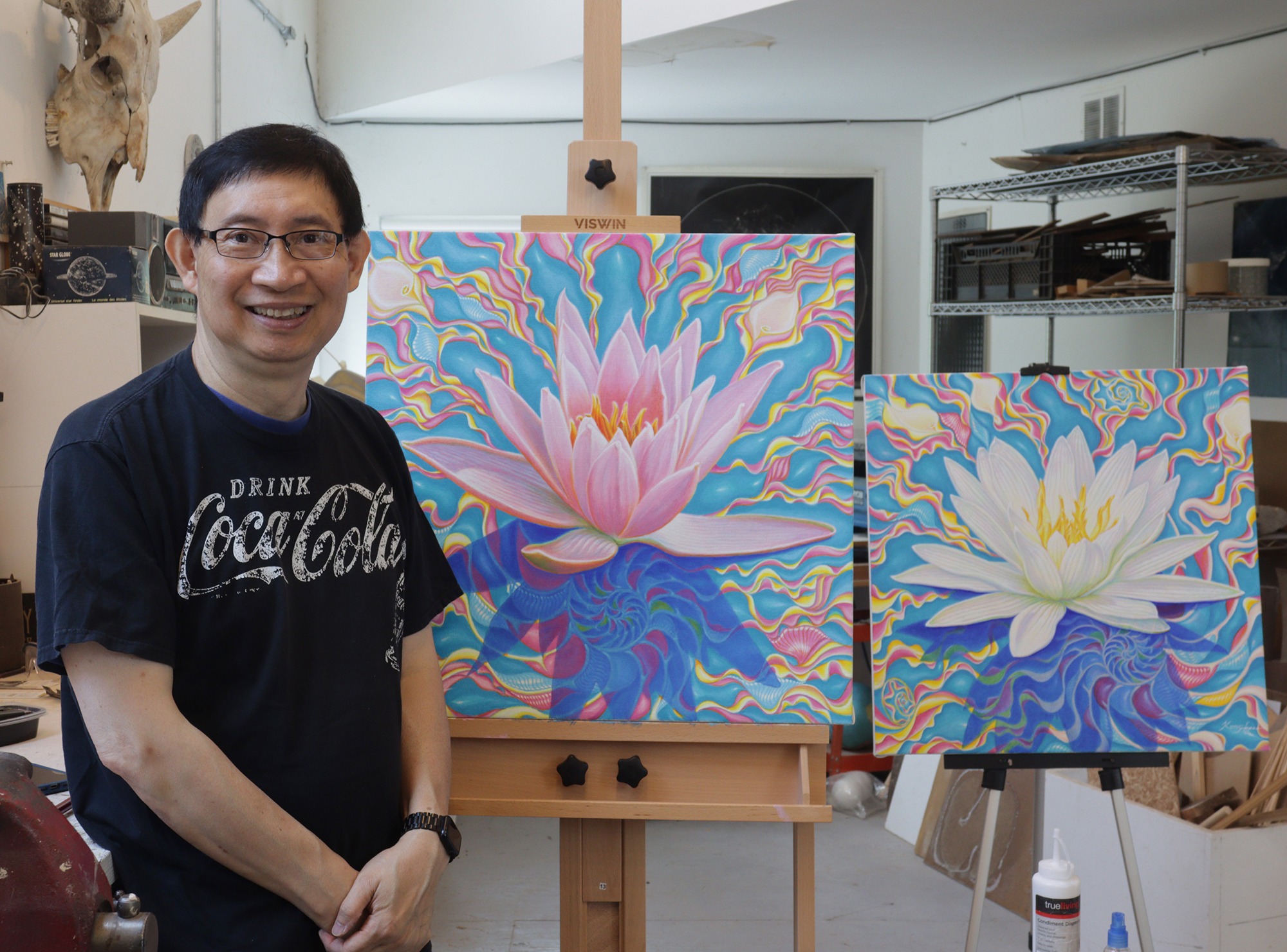
My paintings explore the tension between the fleeting and the enduring—between the desire to remain fully present in a moment and the human impulse to preserve what is already passing away. Through my ongoing Luminosity Series, I investigate impermanence, memory, transformation, and transcendence by bringing together precisely rendered botanical imagery, bisected nautilus shells, layered acrylic glazing, and free-flowing patterns. My work exists between representation and abstraction, creating an imaginative space where natural forms simultaneously emerge, dissolve, and transform.
My artistic language has developed through my experience of Eastern and Western cultures. Rather than treating these influences as separate traditions, I approach them as interconnected ways of seeing and understanding the world. Zen Buddhist ideas of presence, impermanence, and mindful awareness inform my contemplation of nature and time, while Western traditions of floral still life, trompe l’oeil, and illusionistic painting influence my attention to observation, structure, and visual precision. This synthesis allows cultural experience, philosophical reflection, and personal history to coexist within a single pictorial environment.
Flowers and nautilus shells serve as recurring visual and symbolic anchors. I am fascinated by flowers because their extraordinary beauty is inseparable from their fragility. A bloom reaches its fullest presence only briefly before beginning to fade. The nautilus spiral, by contrast, suggests continuity, growth, rhythm, and the accumulation of time. By bringing these forms together, I create a visual dialogue between ephemerality and endurance. Natural imagery becomes more than subject matter; it becomes a means of contemplating growth, decay, renewal, and the cyclical processes that connect human experience with the natural world.
My compositions balance discipline with spontaneity. Controlled layers of transparent and translucent acrylic glazes generate luminosity and depth, while meandering lines, sweeping ribbons, folding petal veins, floating forms, and improvised patterns activate the painted surface. Circular floral and nautilus structures often push against the angular boundaries of the canvas. Forms overlap, fragment, disappear, and reappear within dense fields of color and pattern. These shifting relationships disrupt conventional spatial logic and produce an ambiguous environment that is neither entirely physical nor imaginary. I think of this space as transcendental—a pictorial realm in which perception remains fluid, and transformation has neither a clearly defined beginning nor an end.
Color also carries emotional and autobiographical significance. Blues, magentas, and their shifting relationships evoke a Yin-Yang-like balance while connecting new sensory experiences with memories of places I have known. Having lived and worked across different countries and cultural environments, I have repeatedly experienced the relationship between relocation, belonging, and memory. Local plants and flowers can unexpectedly reconnect me with earlier places and moments, transforming observation into nostalgia. Nature therefore becomes a bridge between where I am, where I have been, and what remains within memory.
At the center of my work is a paradox: I know that an ephemeral moment cannot truly be preserved, yet I continue to try to hold on to its essence through painting. A flower disappears, a place changes, and an experience becomes memory, but each can leave a trace that continues to shape the present. Painting allows me to give material form to that trace without pretending that time can be stopped. This tension between fleeting beauty and the desire to preserve and understand it lies at the heart of my artistic inquiry.
Ultimately, my paintings embody the bittersweet condition of being in-between: between past and future, attachment and detachment, representation and abstraction, material presence and spiritual longing. I invite viewers to enter these luminous, ambiguous spaces and experience their own shifting associations. Rather than offering a fixed interpretation, I hope the work creates a contemplative encounter in which beauty, memory, and transformation remain open-ended—reminding us that what is fleeting can nevertheless leave an enduring presence.